Program reportNov. 24, 2026
Eight FBS head coaches have been fired this season, and more jobs will open after the last regular-season games. So we asked one question about every head coach hired since 2022: how good is his team now, compared with the 1 to 3 seasons before he arrived? Same rule for every school.
How we measured
We use Y-Power, the Yardstick’s power rating. It measures how well a team plays from yards per play and points, adjusted for who it played. It does not look at wins and losses. For each coach, we take the team’s average Y-Power in the 1 to 3 seasons before he arrived and compare it with 2026. A score of +1.0 means one Y-Power point better than before he came.
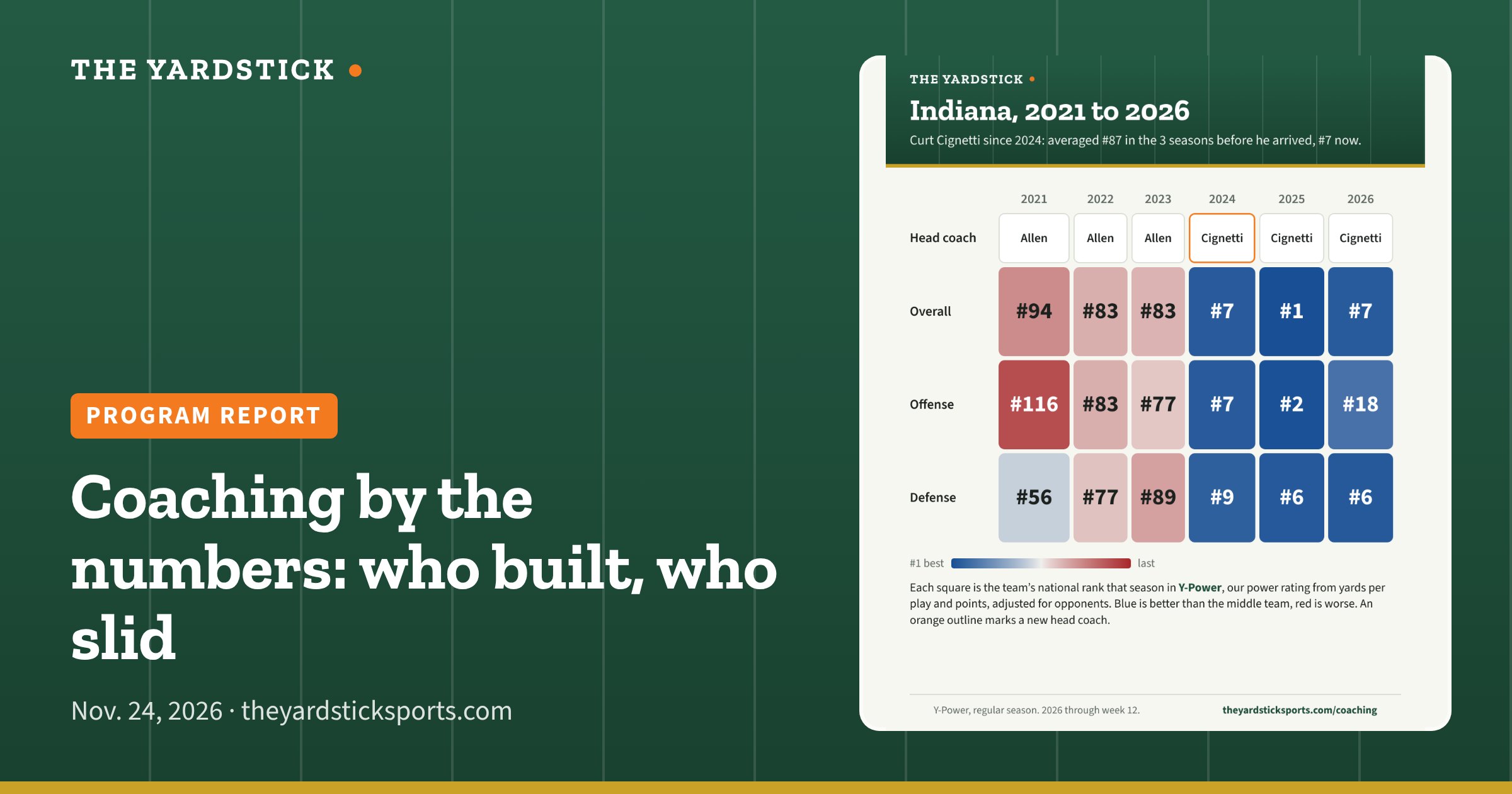
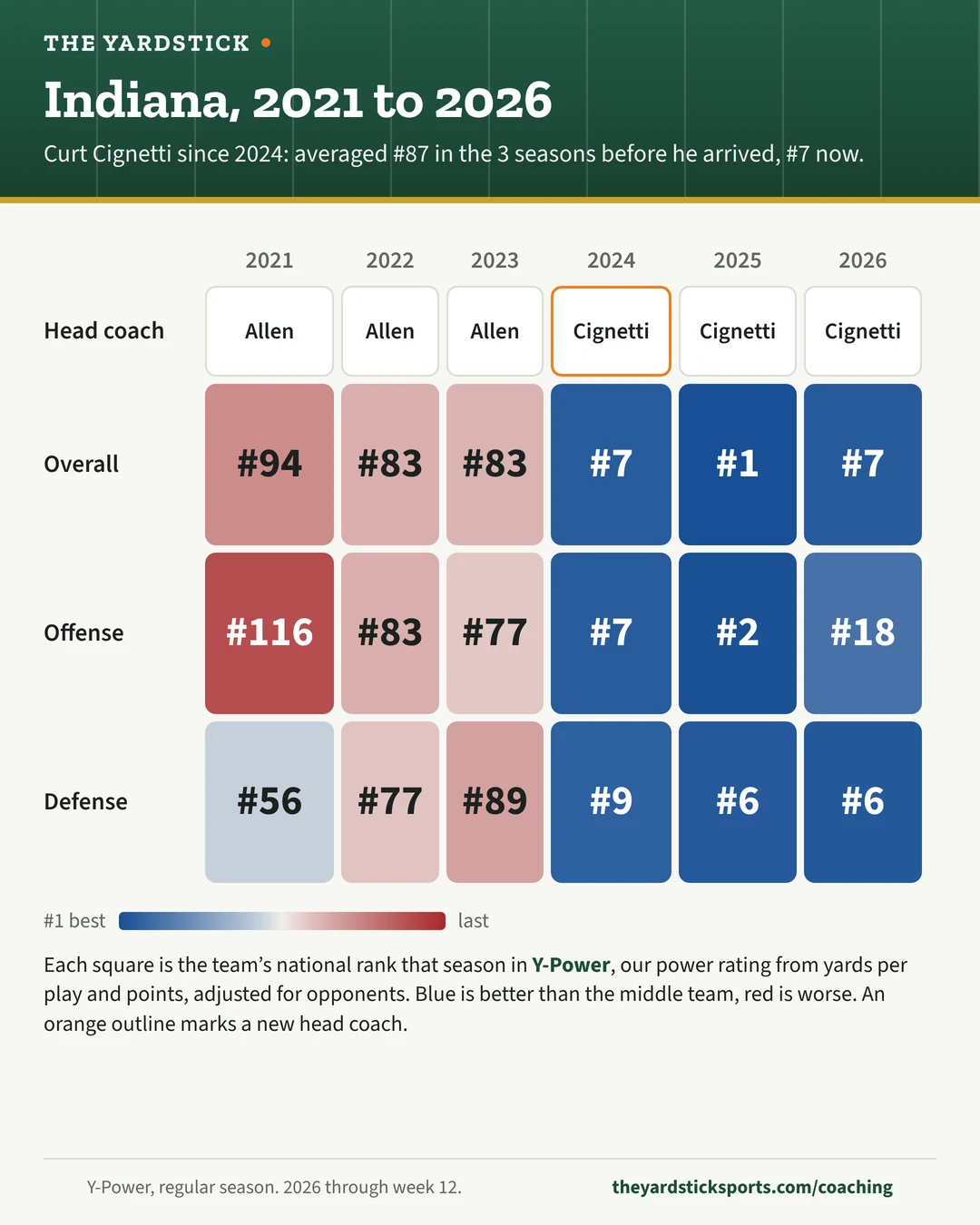
Indiana is the clearest example. In the three seasons before Curt Cignetti arrived, Indiana ranked #94, #83 and #83. In his three seasons it has ranked #7, #1 and #7.
The biggest climbs
These five head coaches lifted their programs the most, across every FBS program:
- Curt Cignetti, Indiana: averaged #87 before he arrived, #7 now.
- Jason Eck, New Mexico: averaged #119 before he arrived, #38 now.
- Jake Dickert, Wake Forest: averaged #79 before he arrived, #9 now.
- G.J. Kinne, Texas State: averaged #116 before he arrived, #34 now.
- Tre Lamb, Tulsa: averaged #116 before he arrived, #54 now.
One first-year coach is already in the top 10: Eric Morris at Oklahoma State, #92 to #22. The full list has a switch for major programs, smaller programs, or both.
If your school is hiring
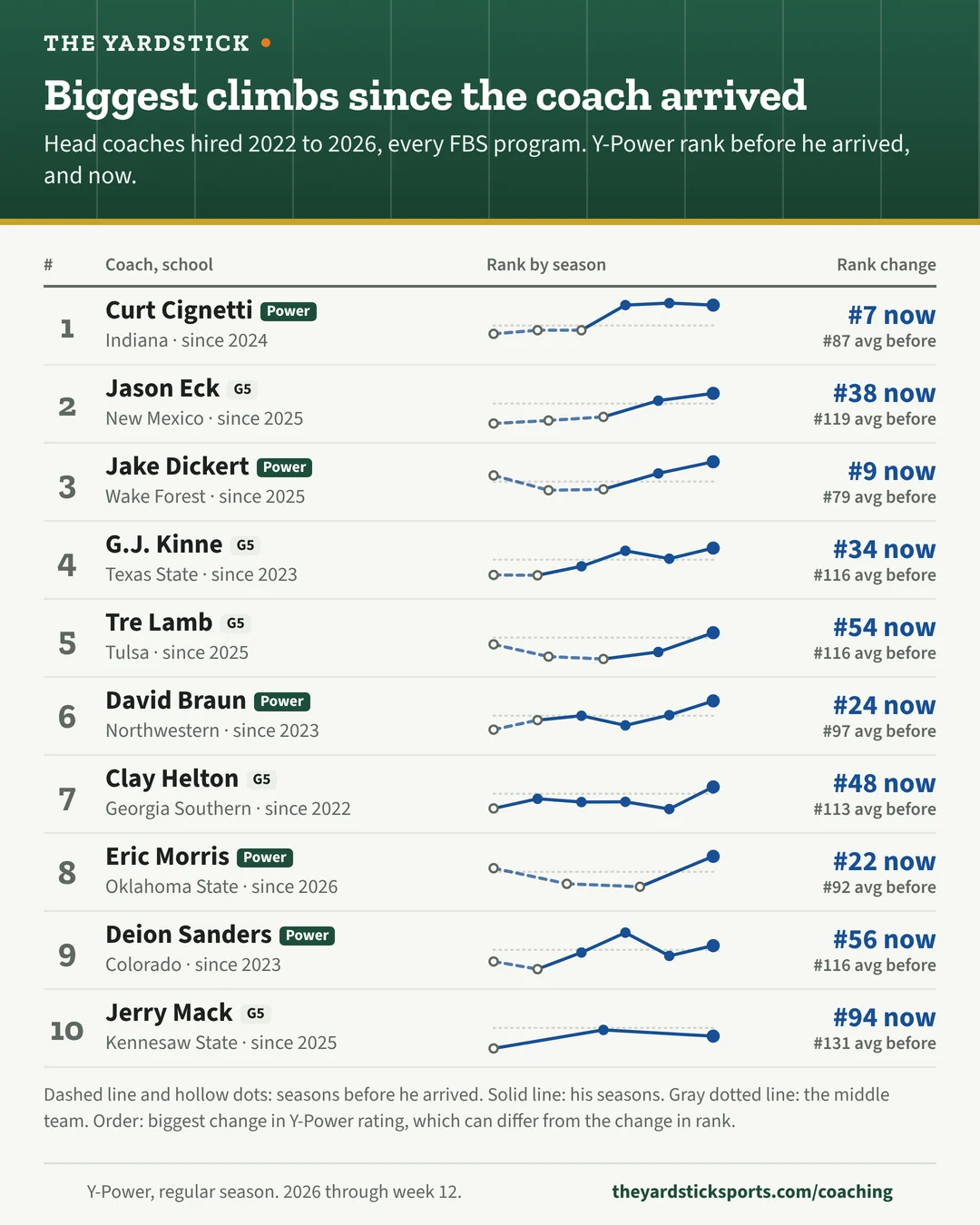
Eight schools have already fired their coach: NC State, UTEP, Sam Houston, Florida State, Baylor, Maryland, TCU and Arkansas State. These coaches run smaller programs (everything outside the SEC, Big Ten, Big 12, ACC and Notre Dame) and lifted them the most:
- Jason Eck, New Mexico: averaged #119 before he arrived, #38 now.
- G.J. Kinne, Texas State: averaged #116 before he arrived, #34 now.
- Tre Lamb, Tulsa: averaged #116 before he arrived, #54 now.
- Clay Helton, Georgia Southern: averaged #113 before he arrived, #48 now.
- Jerry Mack, Kennesaw State: averaged #131 before he arrived, #94 now.
The two at the top got there different ways. Most of Jason Eck’s jump at New Mexico is defense. Most of G.J. Kinne’s at Texas State is offense.
The biggest slides
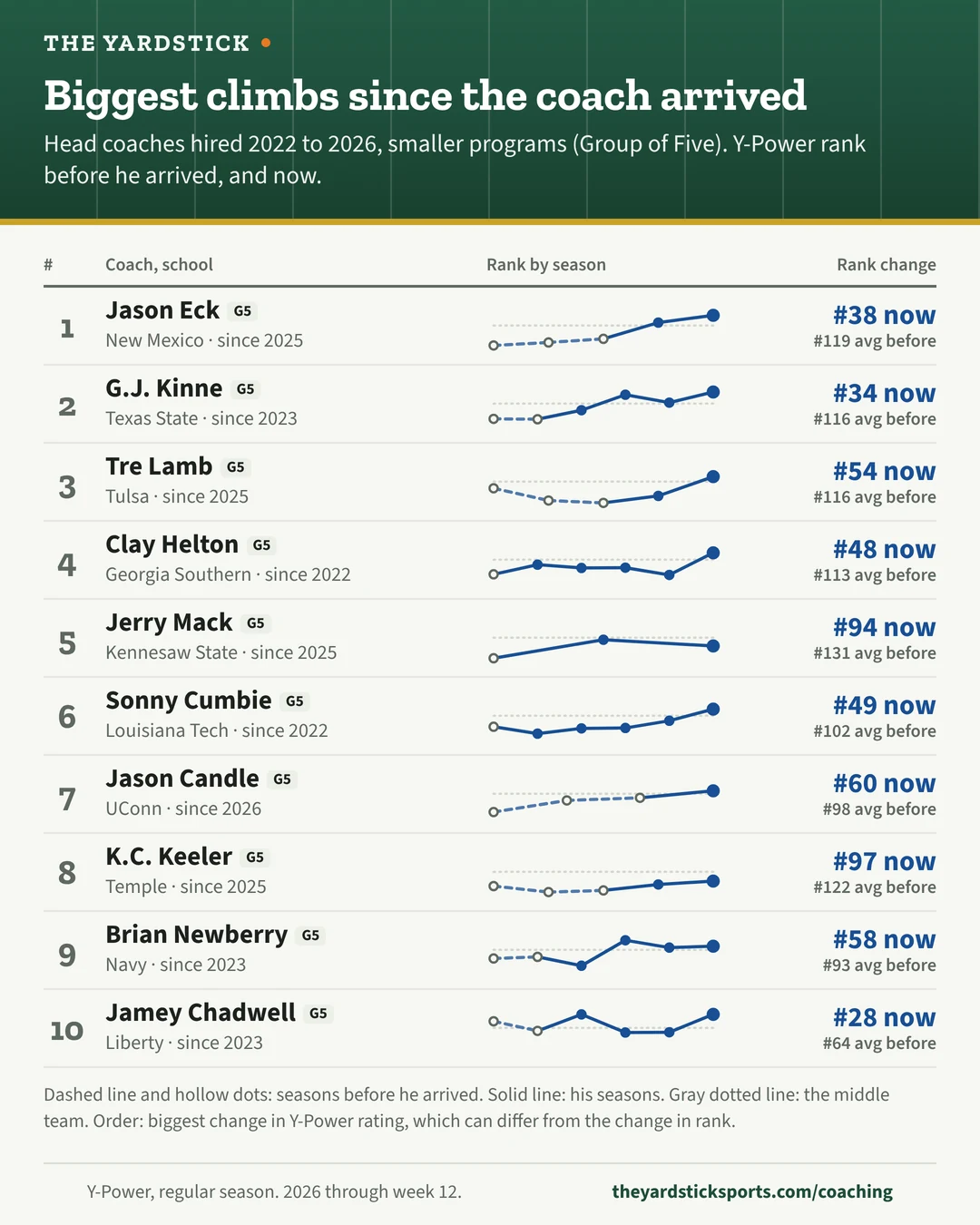
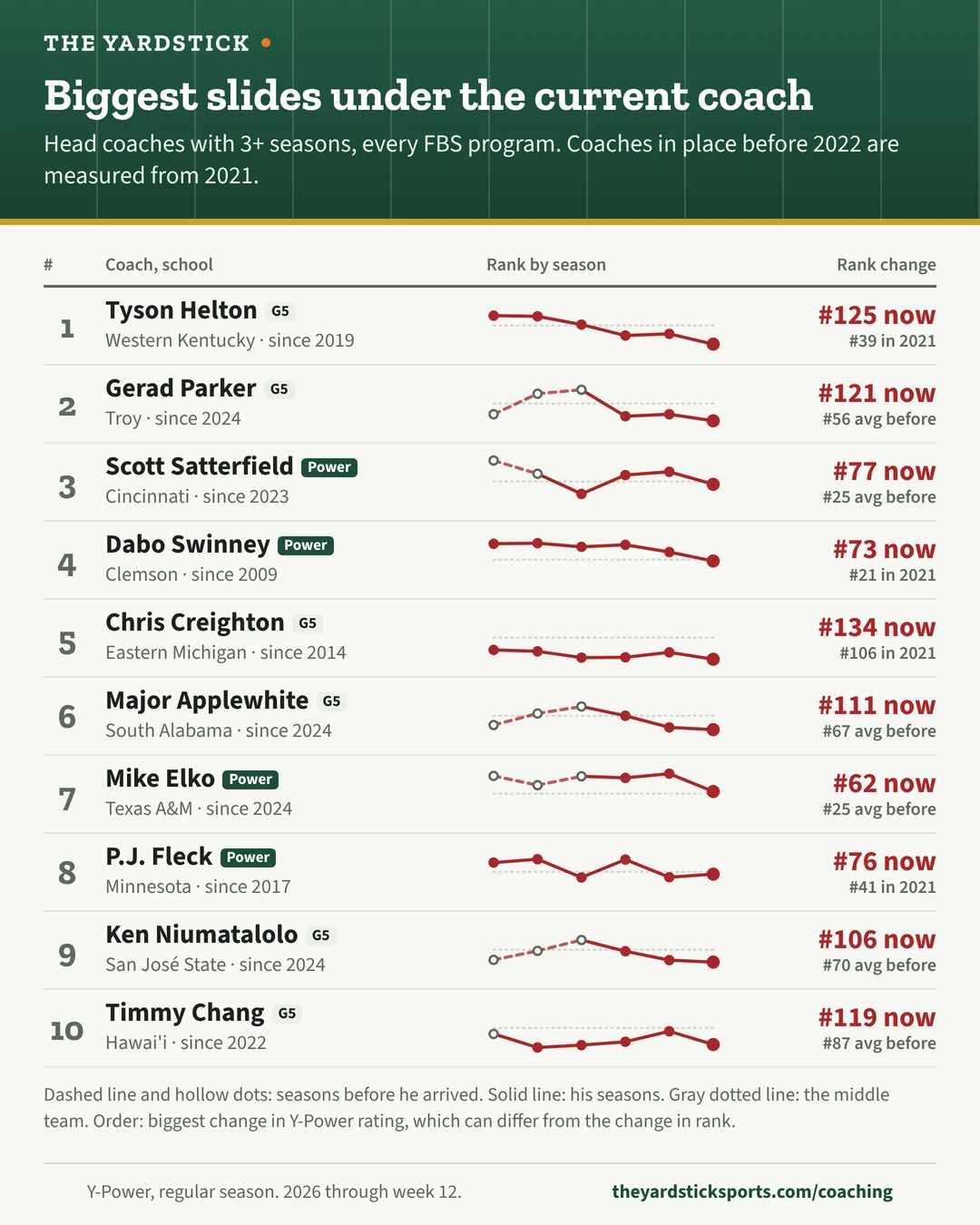
The same rule, turned around, for coaches in at least their third season at their school:
- Tyson Helton, Western Kentucky: #39 in 2021, #125 now.
- Gerad Parker, Troy: averaged #56 before he arrived, #121 now.
- Scott Satterfield, Cincinnati: averaged #25 before he arrived, #77 now.
- Dabo Swinney, Clemson: #21 in 2021, #73 now.
- Chris Creighton, Eastern Michigan: #106 in 2021, #134 now.
Our data starts in 2021. Coaches who were already in place by then are measured from 2021, so their number is the change since 2021, not since they arrived.
Does the score mean anything?
- It finds coaches the market already promoted. Seven coaches left smaller-program jobs for major ones in the last two hiring cycles. Seven of their eight smaller-program stints scored above the typical smaller-program hire.
- It lines up with some of this year’s firings, not all. Out of 103 head coaches with two or more seasons, NC State ranked #2 worst, UTEP #4, Sam Houston #9 and Florida State #18. Baylor (#44), Maryland (#57), TCU (#81) and Arkansas State (#83) rate about the same as, or better than, before their coaches arrived. Those firings were about something this score doesn’t measure.
New coordinators: one season, so we show swings
Coordinators who started this season have one year of data, so we list the biggest one-year swings, not verdicts. The biggest jump: Kevin Decker took over the Memphis offense and moved it from #46 to #5. Old Dominion, the offense he left, fell from #38 to #135, mostly because its quarterback left and only one offensive starter returned. The biggest drop with the same head coach and quarterback: Holmon Wiggins’s Texas A&M offense, #7 to #94, after four of its five offensive line starters were drafted.
What the numbers can’t tell you
Buyouts, recruiting, NIL money, injuries, or how a coach gets along with his school. And one catch in the rule itself: a team that starts near the bottom has more room to climb, and a team that starts near the top has more room to fall.
Check our work
- Coaching by the numbers: the full lists, the coordinator swings, and a five-year grid for every FBS team.
- Charts: every chart on the site in one place.
- Every team page shows its games one by one, and where its rating comes from.
Y-Power, Version 3 of the rules, regular season including conference title games, 2021 to 2026. 2026 is through week 12. Head coaches from CollegeFootballData.com. Firings as of Nov. 24, 2026. Questions or corrections: hello@theyardsticksports.com.